
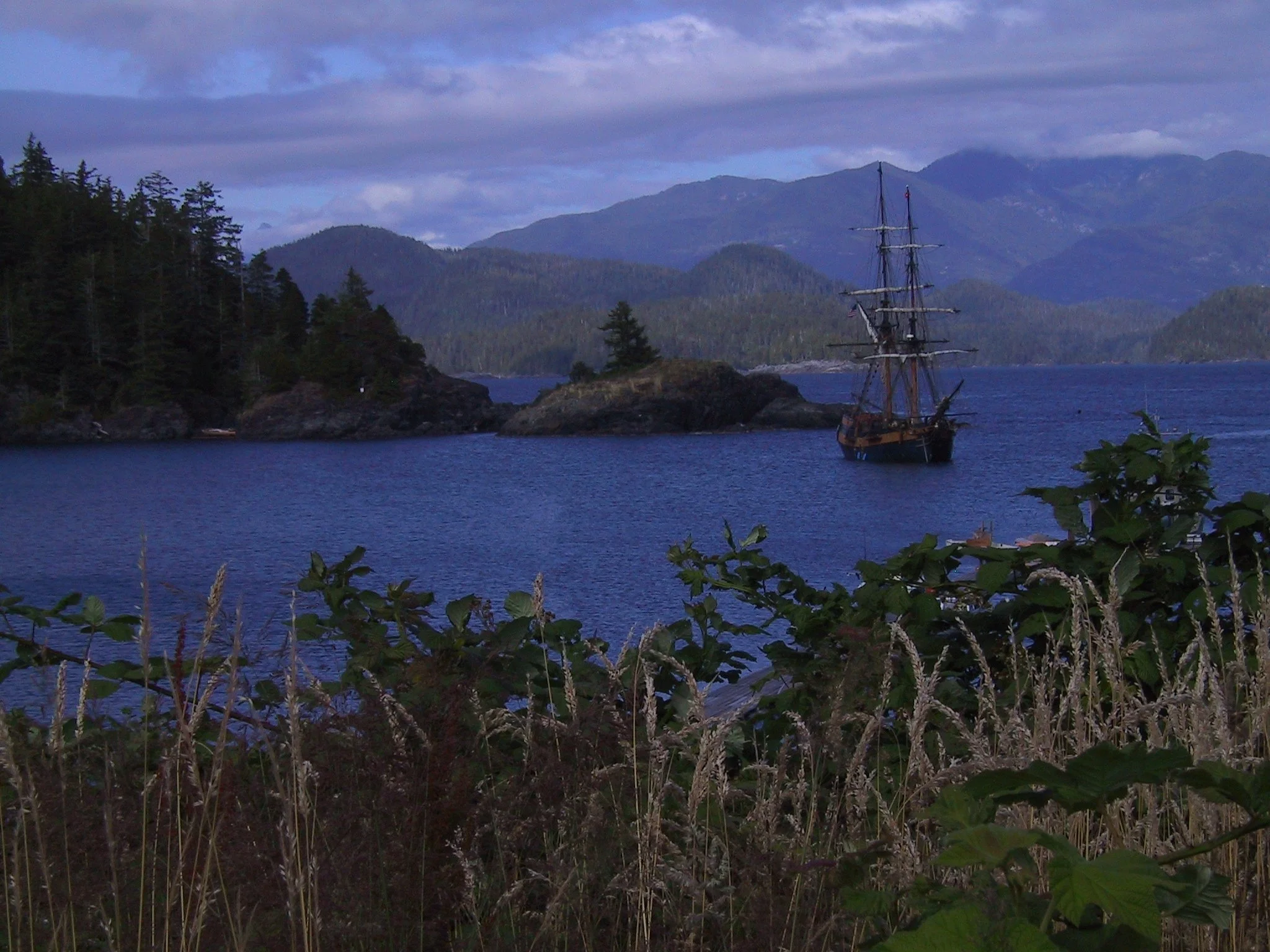
Lady Washington in Friendly Cove. Photo by Captain Mason Marsh
The Morning the Dogs Drowned – Part 1
I was standing anchor watch, the morning the dogs drowned,.
Are they dogs after they’ve gone feral? A rose by any other name would smell as sweet, and if it barks like a dog, I’m calling it a dog.
These dogs were barking, egging each other on in the cold morning twilight, their ghost pack all gray silhouettes against the black sand.
It was mid-August, 2005, and I welcomed the pack’s noisy interruption. Anchor watch is a time for quiet contemplation, but I had no desire for that.
Ann’s scream still echoed in my head.
Yesterday, when Bowditch’s leash wrapped around Ann’s finger, she hadn’t screamed like women do in horror films. That sound makes you sit up in your seat. This sound made the men run pell-mell, as children do down a too-steep hill, with no fear of falling.
It wasn’t anyone’s fault but mine. Bowditch had been stuck on board for far too long and Ann wanted to take him ashore. The hound had cleared customs and could leave the ship, but as Port Captain, it fell upon me to establish a working relationship with every port we visited. I hadn’t, because Opitsat was different, and any descendant of the European invaders wasn’t invited, until a formal apology had been made. The crew was nothing more than glorified taxi drivers., and someone else would be making that apology, so there was no pre-trip prep, and as a consequence, I could not warn Ann that a feral pack had claimed the same beach where we were scheduled to make landfall.
A reason is not the same thing as an excuse.
It was traumatic enough that I remember very little of what happened.
I don’t remember how many men were in my group and I can’t recall if, or how many, dogs died, but I can tell you this: we sail tall ships, and only the sea frightens us.
On that day, we added Ann’s scream to that short list, and the nightmarish yelping squeals, as we waded in with fists and knives.
Years later, a Rottweiler attacked my old dog while we were out walking. The owner of the unruly dog was shocked at my reaction, as I tore into the fight and started pummeling the Rottweiler.
“Back off!,” he warned, “He’ll bite you!”
“Not if I kill him first!,” I remember screaming.
PTSD is real; I have it; and the peace of a perfectly calm morning is a terrible thing: sitting on the tiller of the ship, listening to the faint yip and snarl on a beach. It causes the imagination to wander and find shapes in the sea smoke.
Wait… no… these specters are real.
Bovine forms are rousing from sleep: gaunt, inbred, ugly creatures, grazing among the ashes of place dead for well-over two centuries; the scorched graves of a people and their culture, all because a 36-year-old colonial trader decided to play God and government.
These motley cattle are descended from a herd that was gifted to the handful of fisherfolk remaining, and are a misguided apology by the Canadians.
After the missions, forced relocations, and residential schools, the British Commonwealth decided it was necessary to feed whoever was left.
Dogs and rats were gifted as well, but not as publicly.
Just a few years before the Ann’s scream, Will Twombly, a man dissatisfied with the Americanized story of the piracy of the ship Tonquin and her subsequent destruction, dug deep into his family’s history, looking for the human part of the story. Will knew he was a descendant of American royalty, but he wasn’t buying into the, “We came, we conquered,” version of it. Will was a clinical therapist and knew people were far too complicated for that tiny box.
So he went looking… and right away, started loosing sleep, because it turned out that Robert Gray, the man who had all but handed the West Coast to the thirteen colonies, Gray, the captain of Columbia Rediviva and Lady Washington, was not only his many times great grandfather, but the mass murderer of a nation…
… so Will decided to do something about it, and as a therapist, to help, is to first understand the hurt. The dead are dead - and while that loss of continuity is terrible and heartbreaking, why had a culture also died?
Will found the brig Lady Washington while he was searching for that answer.
We joined his search.
Several years later, stars aligned, funding was raised, and Will at last understood something about the hurt: His ancestor had humiliated the village elders, by kidnapping them, shaving their heads, then tarred, and feathered them.
As an encore, he shelled their village.
Without leadership, and with so many dead, the people of Opitsat lost direction. Even after the seasonal fisherfolk’s return, there was no structure, physical or otherwise, to build on.
The people of Opitsat never recovered, and could not, until the status of the elders was restored.
To do that, Will would need to gather his relatives and sail to the island, knowing that not one book in Opitsat described the sins of his fathers.
Instead, something far more damning did: those afflicted with the generational trauma of that genocide had fought back against the rewriting of their history by leaving all the evidence in plain view, and placed the their island under strict quarantine - no whites allowed - while retelling their story, word-by-word, generation-after-generation, until Will finally contacted them.
Will said that he would bring the sons and daughters of the invaders from their stollen homes and meet with those who had been wronged; that he would meet with any of the elders remaining, and publicly apologize for the actions of his ancestors, in hopes that the Nation of Opitsat would rise again.
Lady Washington was to be his ship.
I had fought the tidal currents of the fjords along Vancouver’s western flank for days, only making fast on Clayoquot Sound after a horribly botched first attempt. The brig now swung on 150 feet of iron chain off the village of Opitsat, her cannons lashed with their barrels pointed away from shore.
The white man had at last returned, over two-hundred-years too late. Aboard her were the ancestors of the man who had ended a race of men… we had returned to walk upon the ashes of those long dead… to apologize.
And we had brought yet another dog.
The Morning the Dogs Drowned - Part 2
The pack had whipped themselves into a crazed frenzy as it became light enough to distinguish their individual forms, twisting and leaping through the shallows. Then, like lemmings off a cliff, a group of seven broke from the group, plunging into deep water, egged on by the frantic barking of those left behind.
They swam like a squadron into the fast current, making no attempt to navigate, and as the trees on the far bank bloomed with the pale pink of morning, I watched those seven dogs drown.
They had swum an incredible distance, nearly a hundred yards out, before being swept into the rip current toward Stockdon Island. The sun rose, cleaving a dazzling stripe through the cotton mist. The ship’s binoculars were nearly useless, magnifying the water’s brilliance as well as their silhouettes, but I maintained vigil, feeling someone should witness their suicide.
With their diminishing images burning into my retinae, I watched through a blur of tears as the last silhouette became the tip of a muzzle, then jeweled calm.
I slumped on the tiller in a kind of fog, before hearing the ship’s generator rumble to life.
Bob showed up with coffee a few minutes later. We sat in silence, watching the day warm, waiting for the breakfast bell to clang in the galley.
I pushed food around on my plate and delivered my report in monotone. We were all exhausted, so nobody cared… except Bob. Bobs Haida. Women describe Bob’s voice as warm chocolate. To me, it sounds like a Grizzley snoring.
His growl finally broke the silence. “How many?”
“Seven,” I muttered, and gave up on breakfast.
A ship’s crew is a family that solves problems. Bowditch looked more interested in begging for my leftover bacon, (which Bob ate,) and could offer no dog insight, so we were on our own in solving the mystery of the pack’s suicide.
A lively debate ensued: one sailor was sure that the pack had banished the dogs injured in yesterday's skirmish, while Will held to the theory that we inadvertently reordered the pack hierarchy by fighting them, but his idea was quashed as overly humanizing animals.
In the end, we decided, (after Bowditch stole Ryan’s bacon,) that dogs and sailors were alike, and that the swimmers were akin to the explorers of old: if they made it, fine, if not, too bad.
Bob set his empty plate aside and took a deep breath.
Suddenly every sailor recalled that Bob hadn’t contributed to the dog debate and remembered it was time to do their chores, but Bob stopped the exodus with a rumbled, “Sit!”
Everyone sat. Even Bowditch, who promptly threw up Ryan’s bacon.
“Good enough to eat twice,” Bob said, smiling at the cook, and began his story.
Oddly enough, it was not a story of Raven or Thunderbird, but the tail of the Gingerbread Boy and the Fox.
In the story, Fox promises to keep Gingerbread Boy dry by giving him a ride on his back, while crossing a river. Gingerbread Boy is slowly coaxed forward onto Fox’s head, as fox tires of swimming, and eventually GB is standing on Fox’s muzzle as his host sinks from under him. Then, Snip! Snap! Fox has lunch.
It is only at the end of Haida Bob’s story that we realize the classic tale is not only a story of a baked treat and a fox, but twin tales of gullibility and survival. Fox must not only eat, but also occasionally drown the parasites he cannot otherwise consume.
Bob told us our own childhood story in his own indigenous fashion, repeating lines and adding rhythm, so we would not, could not, should not, ever forget.
He then led us on deck, handed me the ship’s glasses, and motioned to Stockdon Island, half-a-mile distant. I scanned the far shore before passing the binoculars to Ann.
“Seven,” she counted, after a long pause. “They all made it.”